
Convictional
generalTeam communication platform replacing Slack
General LLM tools include frameworks, APIs, evaluation utilities, and infrastructure specifically built around large language models. This category covers 369 tools that help developers build, test, fine-tune, and run applications on top of LLMs, from embedding calculators to full model-serving platforms.
Team communication platform replacing Slack

Fast AI transcription of audio and video

Generate and download AI-created songs instantly

Text-to-audio conversion with multiple languages and voice options

AI speech-to-text and tape transcription service

Persian keyboard, editor, and speech-to-text converter
AI audio transcription for multiple languages

Text-to-video and image-to-video AI

Elixir Phoenix SaaS templates and boilerplate

Video downloader for social media

Generate celebrity voices from text in seconds
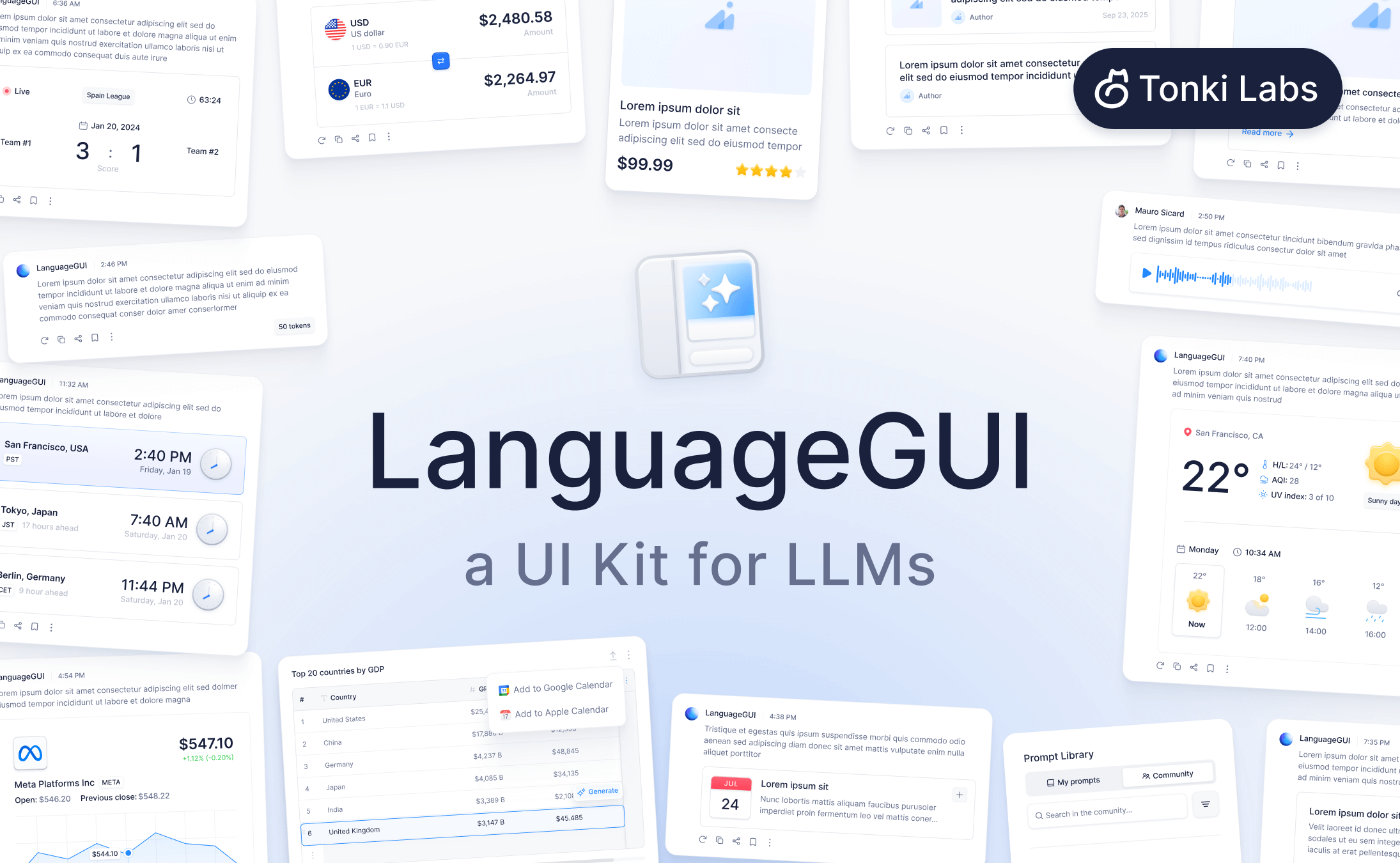
Open-source UI toolkit for formatting LLM outputs as rich interfaces

Create professional infographics with an intuitive AI maker

Participate in AI competitions and benchmark models against thousands
Convert text prompts into scalable vector designs and illustrations

Read PDFs, Google Docs, Word files aloud with immersive text-to-speech
AI notepad that executes your tasks

GPU cloud infrastructure optimized for AI workloads

AI model comparison and evaluation

Cloud GPU platform with NVIDIA H100 for AI workloads
GPU instances for AI training and inference

Open-source GPT models for large-scale deployment
Open-source LLM for local or self-hosted deployment

Data management and labeling for LLM development
This is a technically focused category aimed primarily at developers and ML engineers. Tools like Cognee and UpTrain address retrieval-augmented generation (RAG) pipelines and model evaluation, while platforms like Dstack and PeriFlow handle compute infrastructure for training and inference. Embedding Similarity Calculator and similar utilities fill narrow but useful gaps in LLM development workflows. OpenAssistant and Cerebras-GPT represent open-source or open-weight models that developers can run or fine-tune directly. When comparing options, consider whether a tool is model-agnostic or tied to a specific provider, and whether it supports the models you are already using. Latency, throughput, and cost-per-token are the metrics that matter most for production workloads. Evaluation tools are often underinvested in early projects but become critical once you are shipping to users. Many tools here are open source with paid managed versions, while others are closed SaaS products with usage-based pricing.