VoiceDub
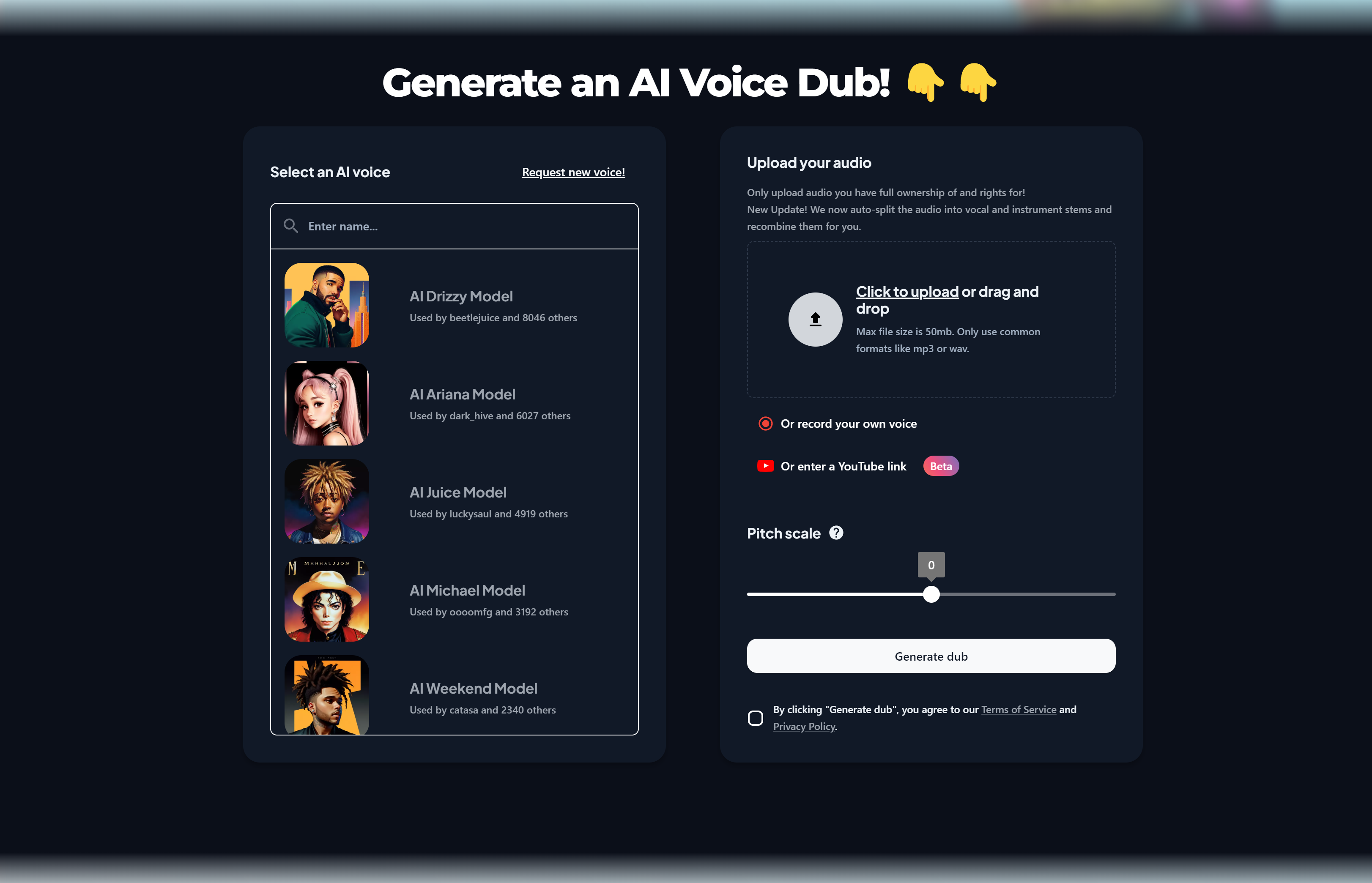
generalAI voice covers for songs with 10,000+ voices
General LLM tools include frameworks, APIs, evaluation utilities, and infrastructure specifically built around large language models. This category covers 369 tools that help developers build, test, fine-tune, and run applications on top of LLMs, from embedding calculators to full model-serving platforms.
AI voice covers for songs with 10,000+ voices

Create and schedule AI photos, videos, and voiceovers

Chat interface to automate tasks in apps

Convert PDFs into interactive courses with adaptive quizzes

Rewrite AI content to read like human writing

Audio and video transcription in 98+ languages

Colors line art sketches and turns them into finished illustrations

Writing tools for brainstorming, drafting, and copy refinement

Converts AI text to match human writing style

Adjust lighting in photos and videos with AI

Organize and search technical documentation across teams

Text-to-speech with natural-sounding voices

Launch, automate, and scale Meta ads from one dashboard

Open-source framework for building AI applications

Translate text in images across 130+ languages

Software deals for entrepreneurs

Generate custom logos from text

Generate story branches and plot ideas

Record and share video messages

Makes AI-generated text read like human writing
AI content creation and SEO assistant

AI medical documentation for clinical notes

Rewrite text for low-literacy users across any language

Make AI-generated text read naturally
This is a technically focused category aimed primarily at developers and ML engineers. Tools like Cognee and UpTrain address retrieval-augmented generation (RAG) pipelines and model evaluation, while platforms like Dstack and PeriFlow handle compute infrastructure for training and inference. Embedding Similarity Calculator and similar utilities fill narrow but useful gaps in LLM development workflows. OpenAssistant and Cerebras-GPT represent open-source or open-weight models that developers can run or fine-tune directly. When comparing options, consider whether a tool is model-agnostic or tied to a specific provider, and whether it supports the models you are already using. Latency, throughput, and cost-per-token are the metrics that matter most for production workloads. Evaluation tools are often underinvested in early projects but become critical once you are shipping to users. Many tools here are open source with paid managed versions, while others are closed SaaS products with usage-based pricing.