
Convictional
generalTeam communication platform replacing Slack
This category covers tools built around large language models: infrastructure for deploying, fine-tuning, evaluating, and monitoring LLMs in production. With 369 tools listed, it is one of the more technical categories on the site, aimed primarily at developers and ML engineers rather than end users.
Team communication platform replacing Slack

Fast AI transcription of audio and video

Generate and download AI-created songs instantly

Text-to-audio conversion with multiple languages and voice options

AI speech-to-text and tape transcription service

Persian keyboard, editor, and speech-to-text converter
AI audio transcription for multiple languages

Text-to-video and image-to-video AI

Elixir Phoenix SaaS templates and boilerplate

Video downloader for social media

Generate celebrity voices from text in seconds
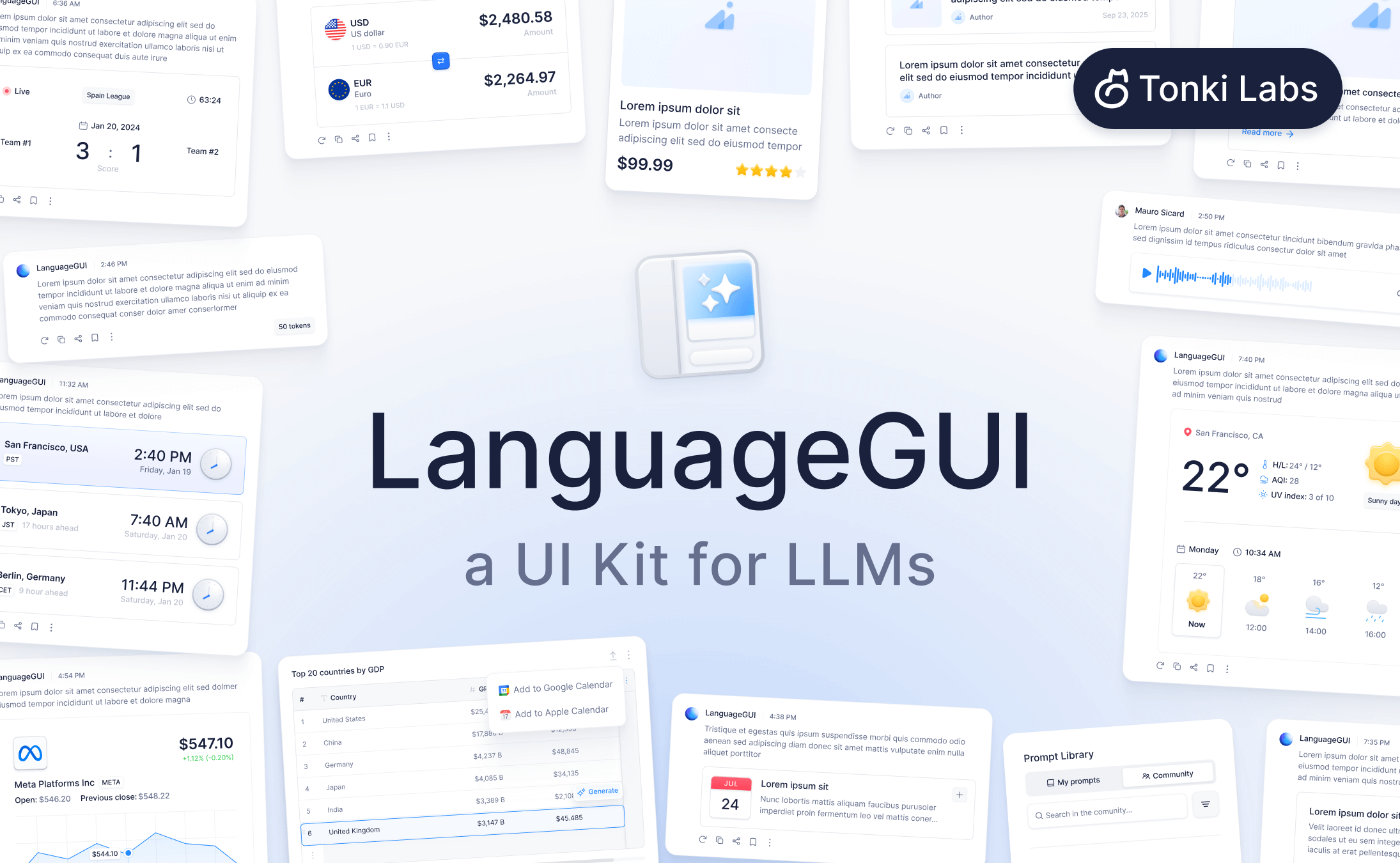
Open-source UI toolkit for formatting LLM outputs as rich interfaces

Create professional infographics with an intuitive AI maker
Participate in AI competitions and benchmark models against thousands
Convert text prompts into scalable vector designs and illustrations

Read PDFs, Google Docs, Word files aloud with immersive text-to-speech
AI notepad that executes your tasks

GPU cloud infrastructure optimized for AI workloads

AI model comparison and evaluation

Cloud GPU platform with NVIDIA H100 for AI workloads
GPU instances for AI training and inference

Open-source GPT models for large-scale deployment
Open-source LLM for local or self-hosted deployment

Data management and labeling for LLM development
LLM tooling has exploded alongside the models themselves, and the category now spans several distinct problem areas. Deployment and serving tools like PeriFlow and Dstack help teams run models efficiently at scale. Evaluation and observability tools like UpTrain and AIWatch track model quality, drift, and cost over time. Memory and retrieval tools like Cognee add persistent context or RAG capabilities to LLM applications. When choosing, the key questions are infrastructure fit (cloud, on-prem, or hybrid), model compatibility (OpenAI-only vs. open-weight models), and whether the tool addresses your actual bottleneck, whether that is latency, cost, accuracy, or developer velocity. Pricing structures vary: some tools charge per token processed, others per seat or per API call. Open-source options exist across most sub-categories, which is worth considering for teams with engineering capacity to self-host.