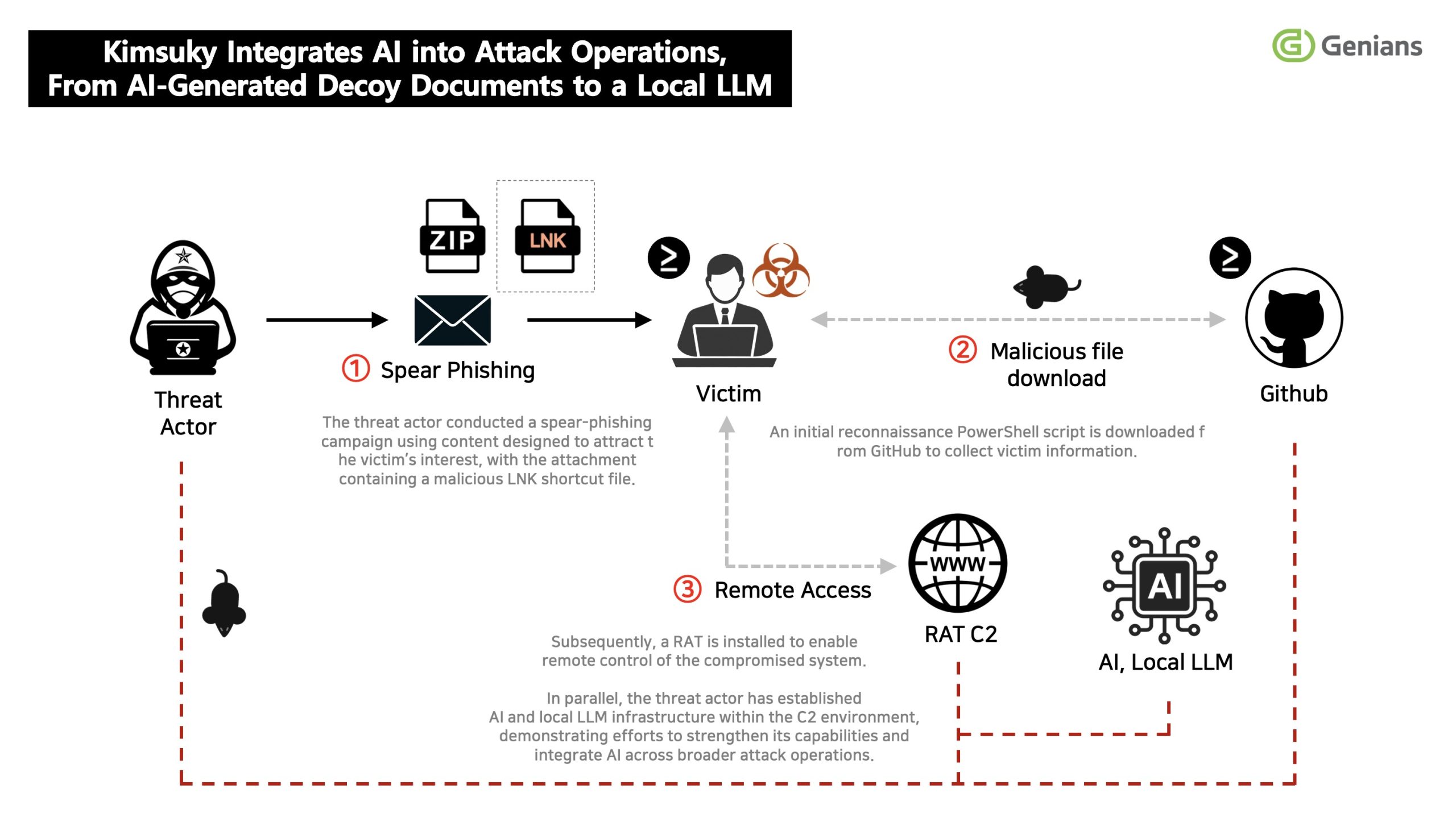
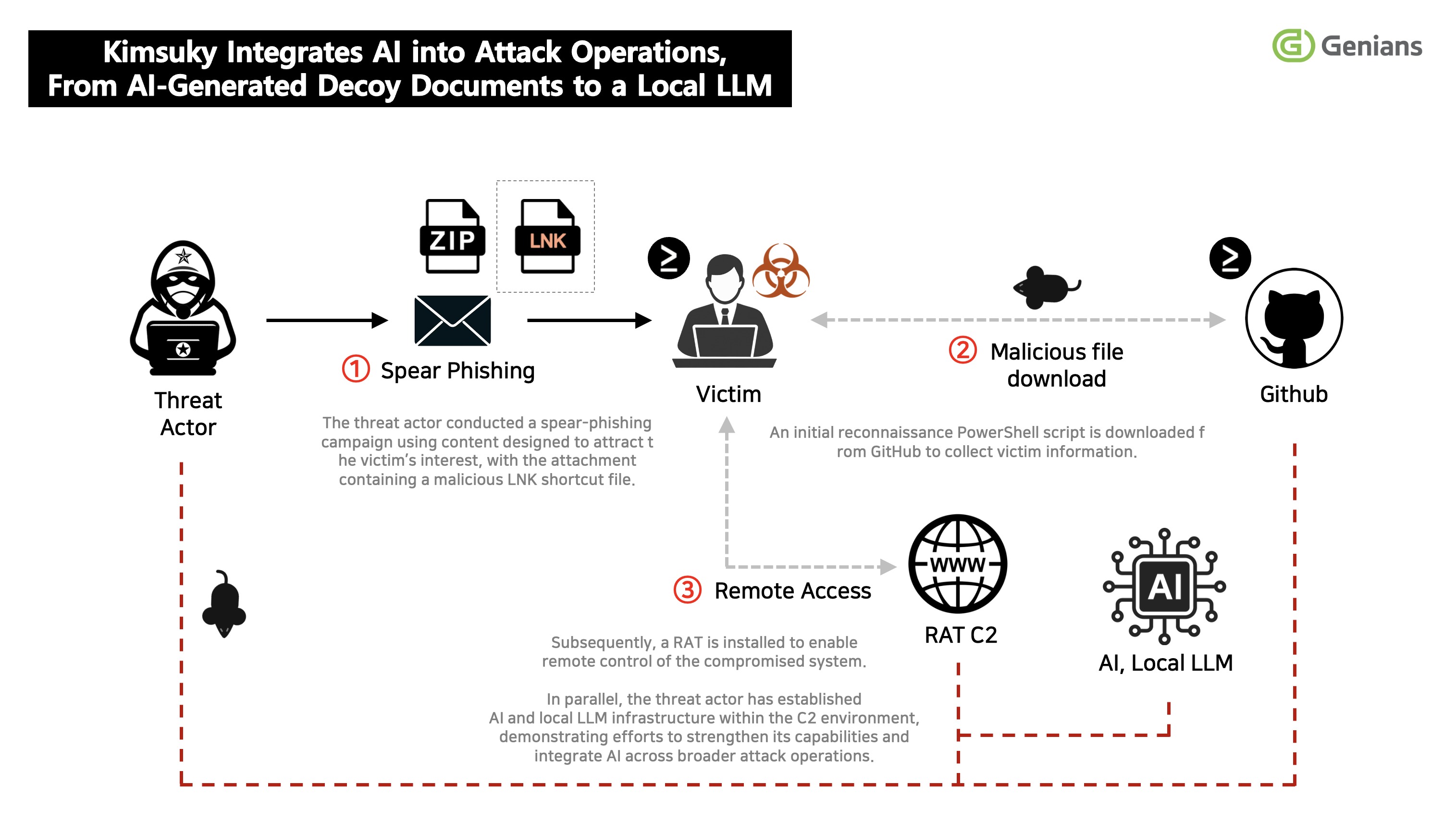
Genians Security Center says it found a Kimsuky-linked environment containing local LLM runtimes, a retrieval-augmented generation setup and components for AI-agent development. The report describes a toolchain assembled around local software, not evidence that the actor trained a new model. Reuters repeated the broad account and noted that the technical findings could not be independently verified.
The report describes an AI-enabled toolchain
Genians says it observed Ollama, GPT4All and Msty on the infrastructure it associated with Kimsuky. It describes a localdocs_v3.db file in GPT4All as an indicator that LocalDocs or RAG had been configured. The report also lists LLaMaSharp, Microsoft Semantic Kernel, Microsoft.Agents.AI, speech-to-text materials and Cursor. Finance- and cryptocurrency-themed decoys are described as polished and structurally similar, with indicators that Genians interprets as automated generative-AI document creation.
The report also mentions familiar delivery behavior, including malicious LNK files, hidden PowerShell, persistence and Git-based infrastructure. These observations are report claims and defensive context. They are not proof of a successful AI-enabled intrusion.
Why local does not mean isolated
These sources do not establish a victim count, exfiltration, operational scale or measurable improvement in Kimsuky's success. Genians says it found no evidence of independent model training. The safer conclusion is narrower: local models and RAG can become part of an attacker's working environment, and a local process can still read sensitive files, use credentials, call tools or export generated documents.
For defenders, offline is a tested network state, not a trust assumption. Put model runtimes, RAG stores, credentials and outbound tools behind separate controls. Log model downloads, document access, generated files, process activity and network calls.
A safe way to test the boundary
- Use a disposable host with outbound access disabled.
- Create a synthetic canary such as
CANARY-LLM-2026and a decoy document. - Run the local model or agent while recording process, file and network events.
- Require the canary to remain inside the host and every read or write to be visible.
- Stop on any unapproved tool action or unexplained egress.
This tests your own containment. It does not independently prove the Kimsuky assessment.
What would strengthen the attribution
Watch for a Genians technical appendix, public indicators or samples, independent replication, and confirmation from a government CERT or law-enforcement source. Until then, keep the attribution at report level and treat the story as a serious security-boundary signal, not as proof of a finished autonomous attack system.
Sources: Genians Security Center report and Reuters.