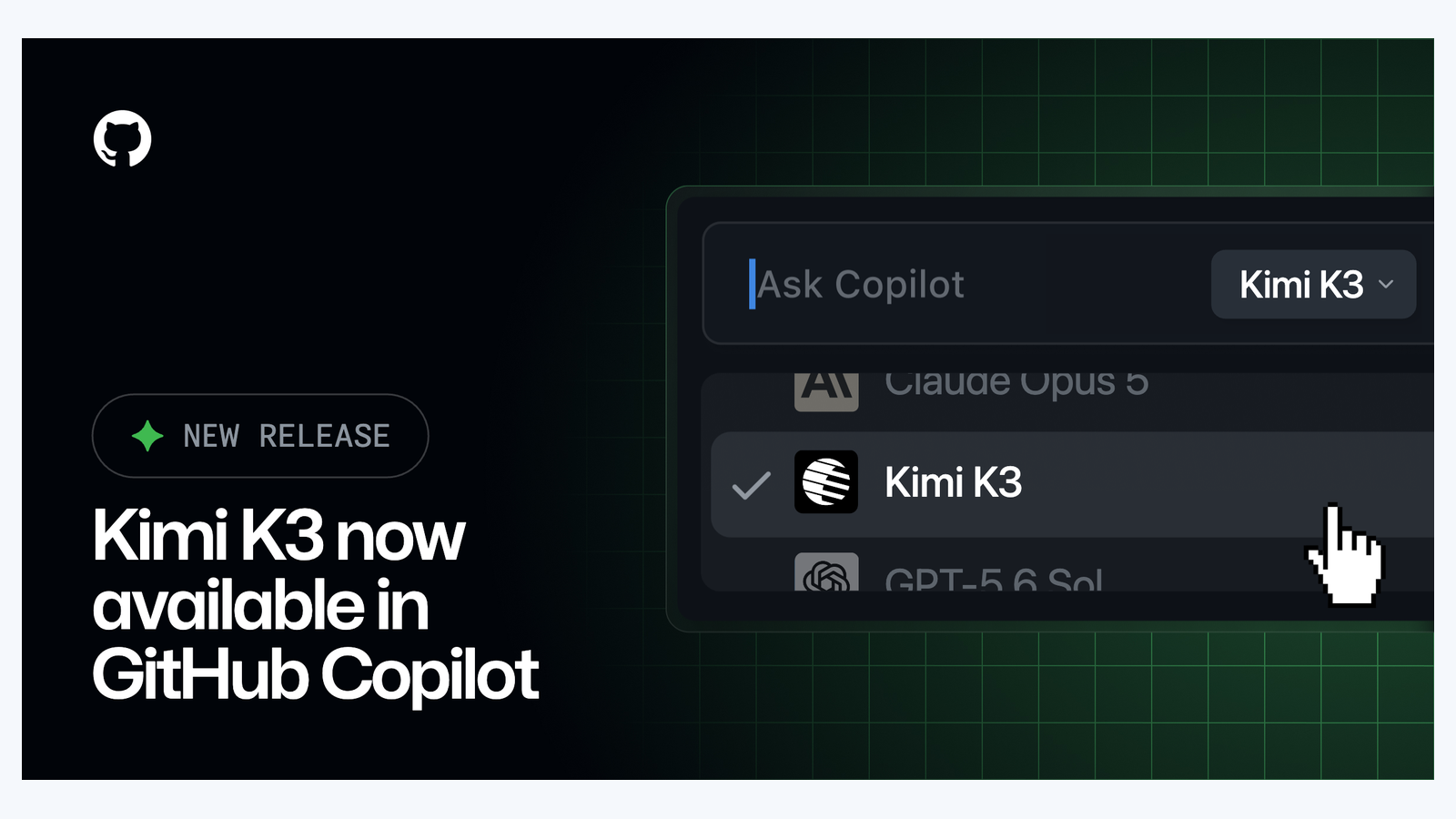
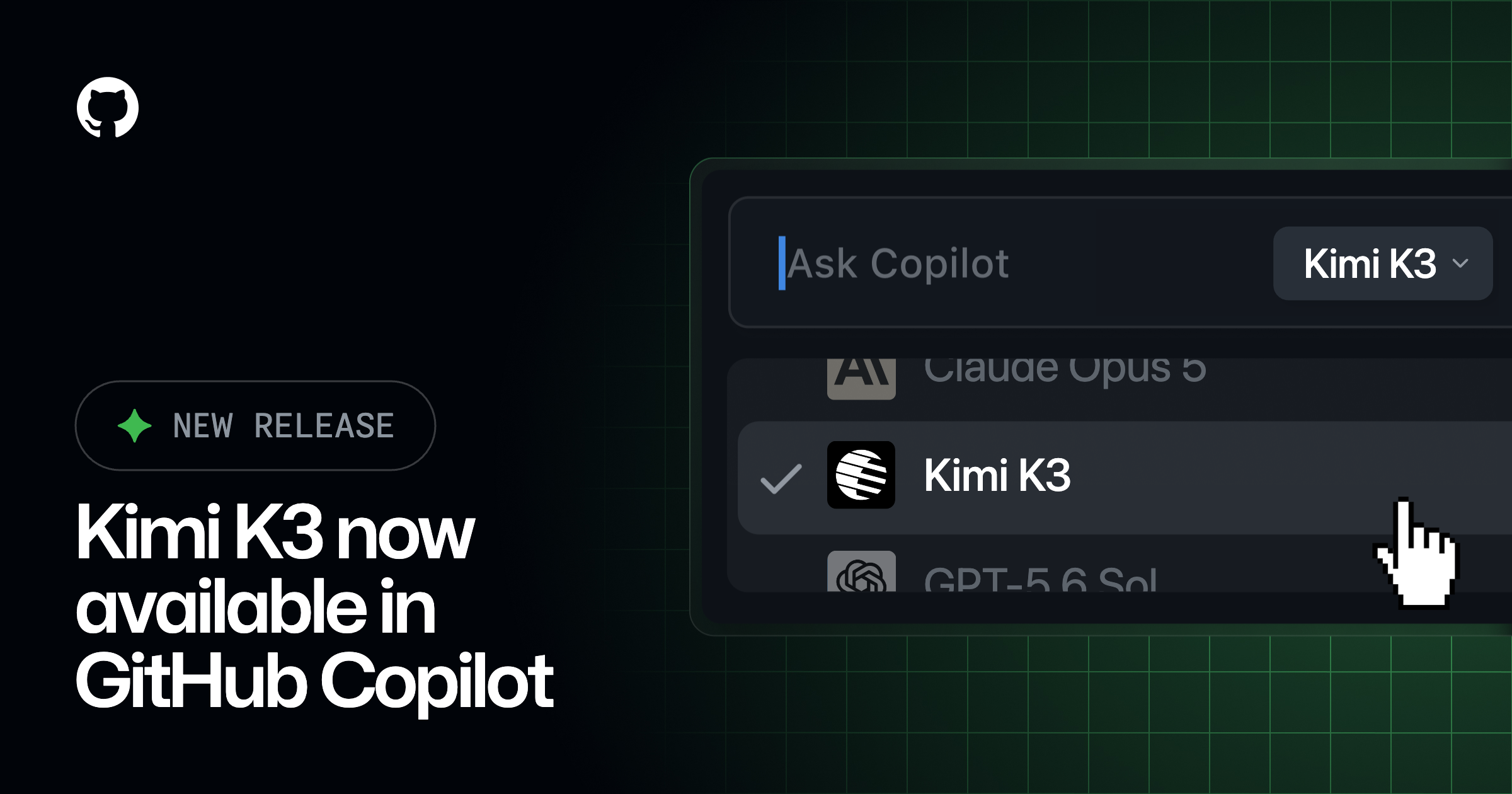
GitHub announced Kimi K3 in GitHub Copilot on 5 August 2026. The changelog labels it generally available, says it is available across Copilot surfaces and describes usage-based billing. GitHub also says Kimi K3 is off by default for Business and Enterprise organizations, where an administrator must enable access. The model choice therefore arrives with both a meter and a governance switch.
A model picker with a meter
The changelog lists Kimi K3 as a hosted model through Fireworks and points users to the model picker. Earlier pricing material recorded a $3 per million input-token and $15 per million output-token list price, while subsequent provider documentation and the GitHub page should be treated as the current source of truth. A model-picker label is not a cost estimate for a real task: prompts, tool calls, retries, cache behavior and output length determine the bill.
Business access starts closed
GitHub says Business and Enterprise access is disabled by default and requires administrator action. That is a useful control for organizations that do not want a new open-weight or third-party hosted model to appear in workflows without review. It does not answer where prompts are processed, which retention and regional terms apply, or whether the model is allowed for every repository and data class.
Open-weight availability is also not a substitute for enterprise governance. Check the provider, subprocessors, logging, retention, access policy and incident path before enabling the model for private code.
Price per task beats price per token
GitHub records a rollout pause after Kimi K3 triggered unexpected GitHub Actions usage. The changelog says the rollout resumed after the issue was resolved. That detail is operationally more useful than a headline rate: an agent can create cost through workflows even when the model's token price looks competitive.
Compare Kimi K3 with the incumbent model on a fixed set of tasks. Measure accepted changes, retries, tool calls, runtime, tokens, workflow minutes, human review and total cost. Keep any vendor list price labeled as a rate, not a forecast.
Run the pilot where it will be used
- Enable the model for a test organization or repository only.
- Keep network, secrets and Actions permissions at their minimum.
- Run identical coding tasks with Kimi K3 and the current default.
- Record model, provider, date, token and workflow costs.
- Ask the administrator to review logs and disable the model after the pilot.
Watch for updated GitHub and Fireworks pricing, retention terms, regional availability and independent task comparisons. Kimi K3 is a new choice in Copilot; the decision should be based on governed task cost and output quality, not the picker alone.
Sources: GitHub Changelog — Kimi K3 in GitHub Copilot, GitHub supported models and Fireworks Kimi K3.