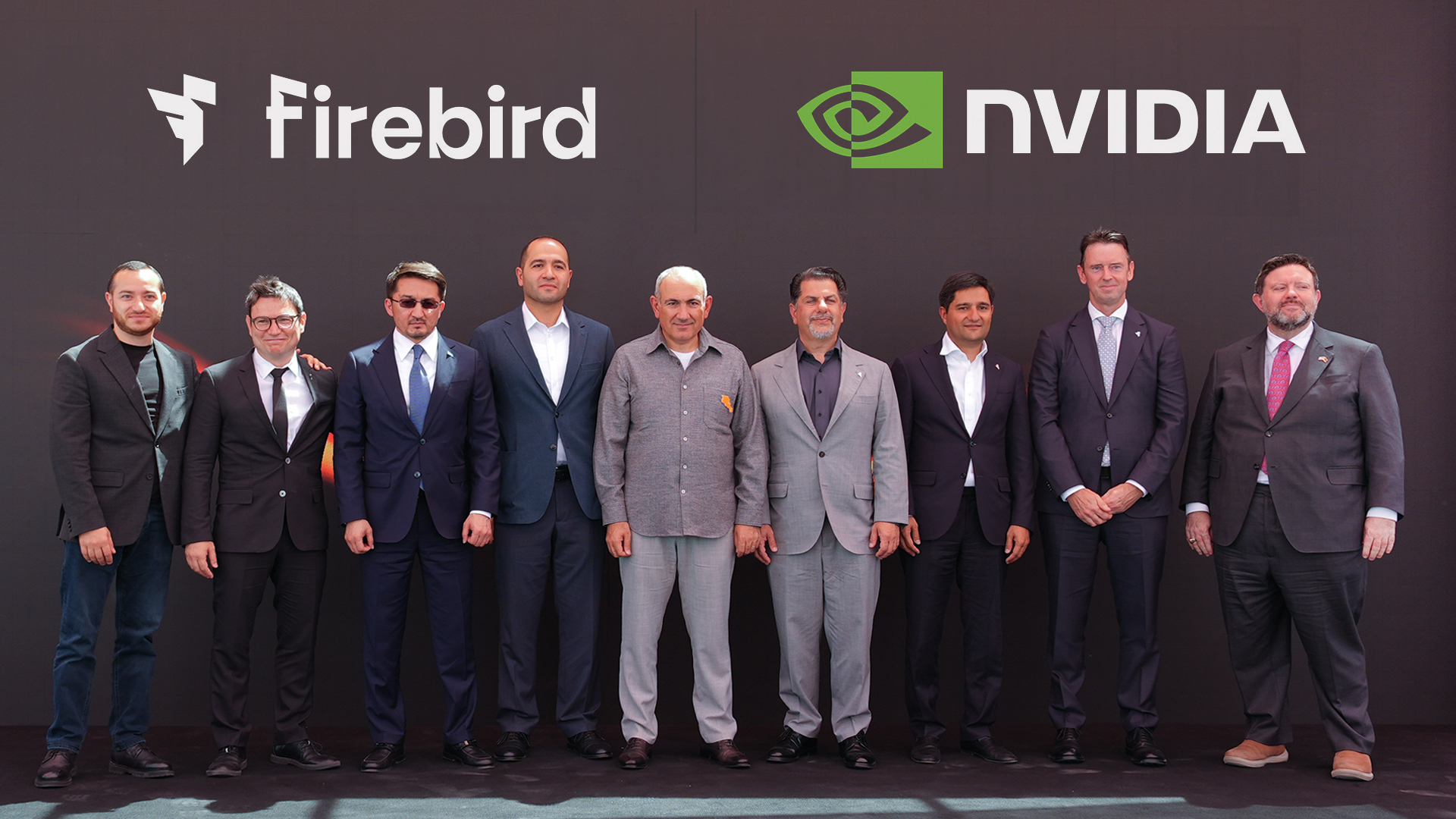
On 8 August 2026, the Armenian government said it officially opened the Firebird AI factory near Hrazdan. The government announcement describes a staged compute plan, while NVIDIA gives a separate end-of-2027 roadmap. That makes the event a meaningful regional infrastructure signal, not proof that an external user can already buy a new cloud service.
Two official views of the roadmap
The Armenian government says phase one is planned at more than 6,000 NVIDIA Blackwell GPUs, around 18 MW and $500 million of investment. It describes a second phase above $4 billion with about 50,000 Vera Rubin GPUs, then an approved expansion expected by the end of 2027 to exceed 100,000 combined Blackwell and Vera Rubin GPUs and 400 MW. The government also says it plans to acquire $25 million of compute resources for researchers and startups.
NVIDIA uses another frame: more than 70,000 Rubin and Blackwell GPUs and 300 MW in Armenia by the end of 2027. Its post also cites Firebird's roughly 2 GW worldwide ambition, DSX capacity of up to 40% more GPUs on the same footprint, and Perplexity as an early demand partner. These are official or vendor roadmap statements, not utilization measurements.
| Source | Reported plan | Current status |
|---|---|---|
| Armenian government, phase one | >6,000 Blackwell GPUs; about 18 MW; $500m | Phase plan |
| Armenian government, phase two | >$4bn; about 50,000 Vera Rubin GPUs | Phase plan |
| Armenian government, end-2027 expansion | >100,000 combined GPUs; >400 MW | Expected expansion |
| NVIDIA, Armenia by end-2027 | >70,000 Rubin and Blackwell GPUs; 300 MW | Vendor roadmap |
Capacity is not a service endpoint
Neither announcement supplies public pricing, an API or service endpoint, a service-level agreement, current availability, independent utilization, latency measurements or workload benchmarks. The difference between the two end-of-2027 figures is not by itself evidence of failure; it means the totals cannot be combined into one audited capacity number.
An official opening and a forward-looking GPU count do not show that a researcher can reserve a specific SKU in a named region at a known price. The planned compute-resource agreement may become useful to startups only when eligibility, allocation and terms are public.
The buyer's checklist
- Ask for the public endpoint, region, GPU SKU, price, SLA and current availability.
- Run the same model, prompts, batch size, data and duration against Firebird and a known cloud.
- Record queue time, throughput, latency, failures and total cost by date and SKU.
- Keep regional-latency or supply-diversification benefits separate from observed service performance.
What would make the story concrete
Watch for a working endpoint, verified deployment milestones, researcher and startup access terms, and independent reports of utilization and price. Until those appear, Firebird belongs on an infrastructure watchlist. It may matter to regional compute supply, but it is not a current provider recommendation.
Sources: NVIDIA Blog — Firebird AI Factory in Armenia and Office of the Prime Minister of Armenia.