
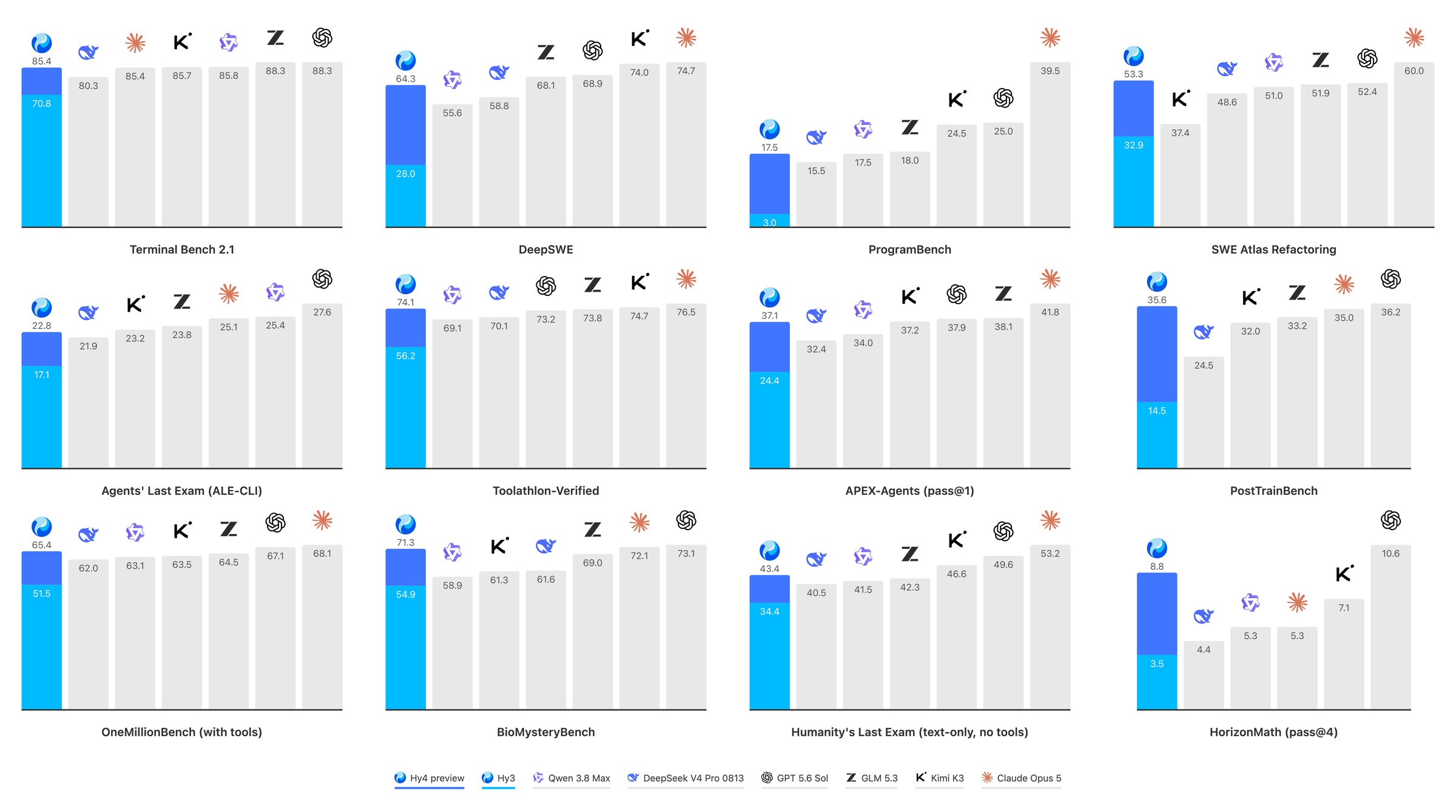
Hy4 preview turns an open-model comparison into a serving decision. Tencent’s official Hy research page is dated August 28, 2026, and the model card presents Hy4 preview as a large open-weight Mixture-of-Experts model with a documented route through vLLM or SGLang. That makes the release relevant to model choosers who can evaluate deployment capacity, not just output quality. It is still a preview, so the useful question is whether it fits a measured workload.
Confirmed model-card details are unusually specific. Hy4 preview has 770B total parameters and 49B activated per token. Its backbone has 78 layers, 256 routed experts plus 1 shared expert, with top-8 routed experts plus the shared expert used per token. It includes one native MTP layer with 10B total and 0.7B activated parameters for speculative decoding. Tencent describes its attention as Gated DeepSeek Sparse Attention with IndexCache and iHC. Context length is 1M, and vocabulary size is 120832.
The release also supplies an operating path. The model card shows an Apache License 2.0 badge, links to Hugging Face, ModelScope, GitCode, and CNB, and includes an FP8 variant. Tencent recommends vLLM or SGLang. The vLLM example uses tencent/Hy4-preview-FP8, --tensor-parallel-size 8, MTP speculative decoding, a sparse attention backend, --tool-call-parser hy_v4, --reasoning-parser hy_v4, and --enable-auto-tool-choice; the SGLang example uses --tp-size 8. These instructions do not guarantee easy deployment.
Tencent says it co-designed Hy4 for software engineering, office/analysis, game development, and scientific research. It reports a blind side-by-side evaluation by 163 internal experts on 203 engineering tasks: Hy4 preview scored 2.99 on average versus 2.92 for GLM 5.3, with 46.8% wins, 12.8% ties, and 40.4% losses. Against Kimi K3, Tencent reports 2.94, with 51.2% wins, 7.9% ties, and 40.9% losses. These figures are Tencent’s internal results, not independent benchmarks.
What is not proven is a general ranking. The supplied evidence does not establish independent benchmark results, latency, memory use, throughput, cost, or quality beyond those 203 tasks. Nor do the release details prove laptop deployment, a specific hardware configuration, a price, or availability. The Apache License 2.0 badge is a documented model-card label; it is not a basis here for extra legal conclusions.
That changes the choice because model behavior and operating burden now arrive together. The 1M context, MoE design, FP8 variant, and native MTP may justify a trial where long context or controlled serving matters. At the same time, 770B total parameters and examples using tensor parallel size 8 make capacity and runtime complexity part of the decision. This is an inference from the published configuration, not a performance claim. Treat open weights as a candidate to operate, not frictionless capability.
Verification should be reproducible. Pin the model and revision, follow a documented vLLM or SGLang path, and run fixed coding and analysis tasks. Compare quality, latency, memory, throughput, and operator effort against an existing model, preserving failure cases and the exact serving configuration. Include complex-reasoning tasks rather than keeping only favorable examples. Tencent calls Hy4 an early version and notes that it can take longer than necessary on complex reasoning and tends to over-verify its work. Watch future model-card or serving revisions and independent tests, but assume no improvement until it is documented. For now, Hy4 preview is a candidate whose model choice cannot be separated from its serving path.