
What is Claude?
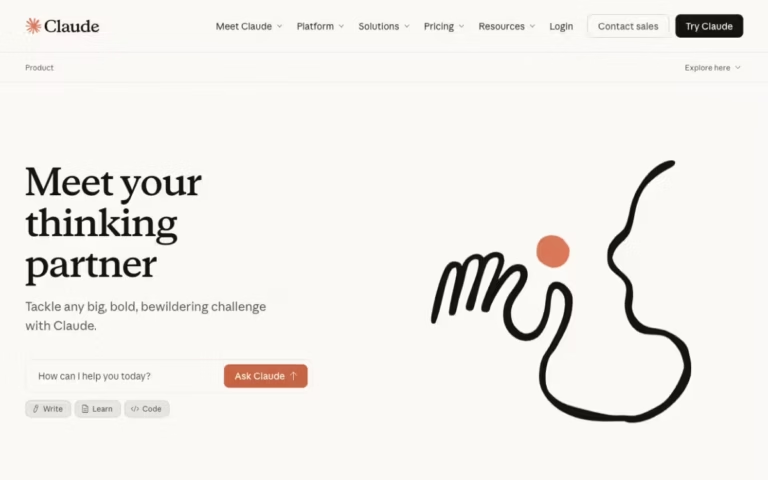
Claude is Anthropic's AI assistant, used through the web at claude.ai alongside desktop apps for macOS and Windows and mobile apps for iOS and Android. It works as a general thinking partner for writing, coding, research, analysis and content creation rather than a single-purpose tool.
It is one of the leading consumer AI assistants of 2026 alongside ChatGPT, Gemini and Copilot, and is built by Anthropic, an AI safety and research company.
Key capabilities
Beyond plain chat, Claude can search the web, read and analyze uploaded files — PDFs, Word and Excel documents and images — and generate and run code.
Two features shape its workflow: Projects, which keep related conversations and their context together, and Artifacts, which turn a prompt into an interactive tool or visualization you can use directly in the chat. Claude also keeps memory across conversations and offers a voice mode for speaking to it.
Who it is for and common use cases
Anthropic positions Claude for professionals and teams across legal, security, customer support, education, financial services, healthcare, life sciences, government and nonprofit work, from individual users to startups and enterprises.
Typical use cases are long-form writing and editing, software engineering, analyzing long documents and codebases, research and summarization, and building small interactive tools through Artifacts.
The Claude model family
Claude is offered as a family of models: Opus for the hardest reasoning and coding, Sonnet for balanced everyday use, and Haiku for the fastest, lowest-cost calls. Anthropic's product pages also list newer Mythos and Fable models.
Recent Claude models support a large context window — reported at up to around 200,000 tokens — so you can paste an entire codebase or long document and ask questions without losing earlier context.
Pricing explained
Claude is free to start. The Free plan ($0) covers chat on web, iOS, Android and desktop, web search, code generation and memory across conversations.
Paid plans add usage and features: Pro from $17/month billed annually ($20 monthly) adds Claude Code, unlimited projects and access to Research; Max from $100/month adds 5x–20x usage and priority access; Team runs about $25/seat/month for organizations; and Enterprise is sold via sales with usage at API rates. The API is available and priced separately.
Strengths and limitations
Independent 2026 comparisons consistently rate Claude strongest for coding and for following instructions precisely — ask for a specific format, tone or constraint and it tends to hold to it — with strong long-document analysis and writing quality.
Its main limitation is media: Claude has no native image, audio or video generation. It is a text-and-image-input, text-output model, so for image or video creation users pair it with other tools.
How Claude compares
Against the other leading assistants, reviewers tend to give Claude the edge on coding and instruction-following, Gemini the edge on cost and native multimodal tasks plus Google Workspace integration, and ChatGPT the broadest all-in-one feature set including image generation and voice. Perplexity is favored for cited research rather than general assistance.
Closest alternatives to evaluate alongside Claude are ChatGPT, Gemini, Microsoft Copilot, Perplexity and DeepSeek.
Pricing
Pricing from the official site. Always confirm current prices on the vendor site.
Pros & cons
Our analysisPros
- Rated strongest for coding among the major AI assistants in 2026 comparisons
- Follows requested formats, tone and constraints reliably
- Strong long-document analysis with a large (~200K token) context window
- Generous free tier; available on web, desktop, mobile and via API
- Projects and Artifacts add real workflow structure beyond plain chat
Cons
- No native image, audio or video generation (text output only)
- Highest-usage Max plan is expensive, starting at $100/month
- Heaviest features (Claude Code, Research) require a paid plan
What users say
In 2026 head-to-head comparisons, reviewers consistently single out Claude for coding and for precise instruction-following, and praise its writing quality and ability to work through long documents and codebases.
The most common criticism is the absence of native image, audio and video generation, which leads some users to pair Claude with other tools for media work. Cost at the top Max tier is also noted as steep for heavy users.
Editorial summary based on public information.
Best for
Writing, coding and long-document analysis where instruction-following and output quality matter most.
Manually choose competitor  Claude
 OpenAI
 Google Gemini
 Inline Help
 Friday
 Enrol Chat
 OpenClaw Setup
 Gorgias
| Feature | Claude | OpenAI |
|---|---|---|
| Pricing | Freemium | Freemium |
| Price from | $17/mo | $8/mo |
| Free tier | Yes | Yes |
| API | Yes | Yes |
| Open source | No | No |
| Platforms | Web, Desktop, Mobile +1 more | Desktop |
| Models | Opus, Sonnet, Haiku | Openai |
| Context window | 200K tokens | 128k |
| Launched | 2023 | 2025 |
| Integrations | Chrome, Slack, Microsoft 365 +2 more | — |
Top alternatives to Claude
See all alternatives → OpenAI
OpenAI's main chat interface, supporting GPT-4o, image input, voice, browsing, and DALL-E generation
Google Gemini
Google's multimodal AI with long-context processing and built-in Search grounding
Grok
xAI's conversational model with real-time access to X posts

Inline Help
AI-powered knowledge base for customer support

Friday
Get AI suggestions while writing email

Enrol Chat
No-code chatbot builder for websites and messaging apps
Specs
| Pricing | Freemium |
|---|---|
| Price from | $17/mo |
| Free tier | Yes |
| API | Yes |
| Open source | No |
| Platforms | Web, Desktop, Mobile, API |
| Models | Opus, Sonnet, Haiku |
| Integrations | Chrome, Slack, Microsoft 365, Outlook, Google Workspace |
| Context window | 200K tokens |
| Launched | 2023 |
News
Anthropic launches Fable 5.1 for broad use while Mythos 5.1 stays restricted
September 2, 2026
Anthropic’s two 5.1 configurations share model weights but not safeguards. Fable 5.1 is the broadly available option with effort and cache controls; Mythos 5.1 is reserved for vetted organizations and trusted research programs.
Anthropic — Introducing Claude Fable 5.1 and Claude Mythos 5.1
AWS Launches ADOP to Help You Build Data Pipelines Faster Without Live AI Risks
August 23, 2026
AWS released ADOP, a new blueprint that uses AI agents to write data pipelines during setup. The generated code runs in production without calling live AI models.
NVIDIA’s New AVO System Shows Agent Tools Matter More Than Just Raw Models
August 23, 2026
NVIDIA introduced AVO, an AI agent system that tests and fixes code across multi-step tasks. In company tests, the complete system solved complex puzzles where standalone models failed.
AWS Shows How to Cut Bedrock RAG Costs by Over 30% — But Answers Take Longer
August 22, 2026
AWS shared a new design pattern that cuts token use in Bedrock RAG applications by up to 90%. It lowers model bills, but adding a compression step makes answers slower.
Anthropic Adds Invisible Watermarks to Claude Text to Meet EU AI Act Rules
August 15, 2026
Future Claude models will carry invisible watermarks worldwide to comply with EU rules. Here is how the tech works, what it tracks, and what it cannot prove.