

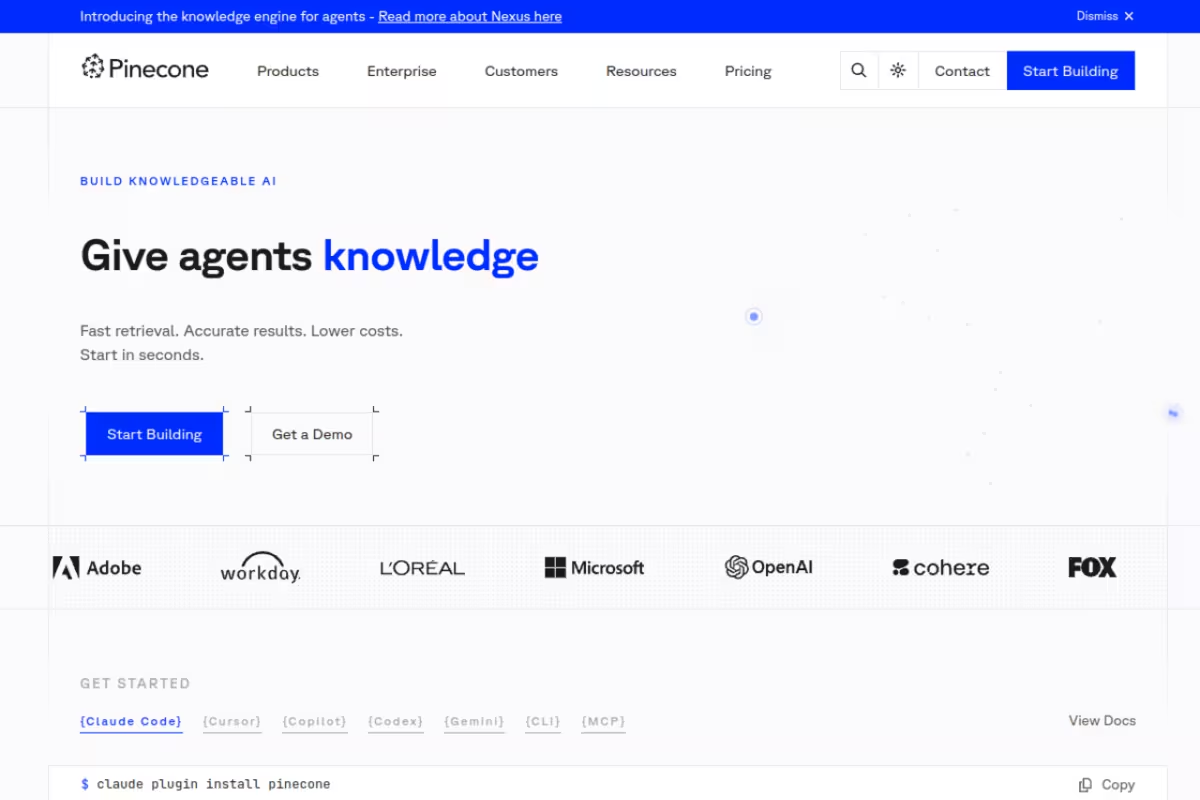
Pros & cons
Our analysisPros
- Searches billions of items in milliseconds
- API-driven semantic search
- Free tier available
- Integrates with Microsoft OneLake
Cons
- No direct API listed despite being API-driven
- Requires embedding pipeline to use effectively
- Scope limited to vector search — not a general database
What users say
Pinecone is commonly used to power similarity search in AI applications — from recommendation engines to retrieval-augmented generation pipelines. A frequently noted strength is its speed at billion-scale vector lookups, which makes it suitable for production AI workloads. A common limitation is that it requires an existing embedding workflow to use effectively, adding setup complexity for teams new to vector search.
Editorial summary based on public information.
Best for
Developers building semantic search or recommendation systems at scale
Manually choose competitor  Pinecone
 Stat Pick
 Uwillfly
 WunderJob
 Kortix Suna
 Synthace
 OmniScholar.Pro
 Webs-Automation
 MyWebSEO.AI
| Feature | Pinecone | Stat Pick |
|---|---|---|
| Pricing | Freemium | Free |
| Free tier | Yes | Yes |
| API | No | Yes |
| Open source | No | Yes |
| Platforms | Web | API |
| Models | Pinecone | Statpickai |
| Context window | 1M | 1M |
| Launched | 2024 | 2024 |
| Integrations | Microsoft OneLake | — |
Top alternatives to Pinecone
See all alternatives →
Stat Pick
Daily AI player prop picks and stats for NBA, MLB, WNBA
Uwillfly
AI flight search with personalized deals and real-time price tracking
WunderJob
CV builder with mentor feedback and collaborative tools

Kortix Suna
Automate workflows with AI and RPA

Synthace
Lab experiment design and analysis

OmniScholar.Pro
Research tool for organizing papers and extracting insights with AI
Verified Jun 2026
Specs
| Pricing | Freemium |
|---|---|
| Free tier | Yes |
| API | No |
| Open source | No |
| Platforms | Web |
| Models | Pinecone |
| Integrations | Microsoft OneLake |
| Context window | 1M |
| Launched | 2024 |