
AWS has introduced new Ray capabilities on SageMaker HyperPod, bringing Ray cluster management into a managed AWS machine learning environment on Amazon EKS. The August 24, 2026 AWS Machine Learning Blog post says the integration uses open-source KubeRay and standard Ray APIs, which is the key design promise: keep Ray familiar while moving more of the operational surface into HyperPod and SageMaker Studio.
The confirmed capabilities are broad. Users can create and manage Ray clusters in SageMaker Studio, view Ray Dashboard and Amazon Managed Grafana dashboards, attach JupyterLab or Code Editor, and submit distributed jobs. AWS also lists hung-job detection, HyperPod node health monitoring with automatic recovery, and tiered checkpointing for faster resume.
For serving workflows, AWS says the launch supports SageMaker JumpStart model weights in Ray Serve, KV cache offloading to tiered storage for long-context serving, and remote endpoints with IAM-authenticated URLs. The post also references the toolkit-for-ray-on-sagemaker-ai for endpoint resolution and EKS credentials. Teams that need lower-level control are not fully boxed in: custom images and YAML remain possible.
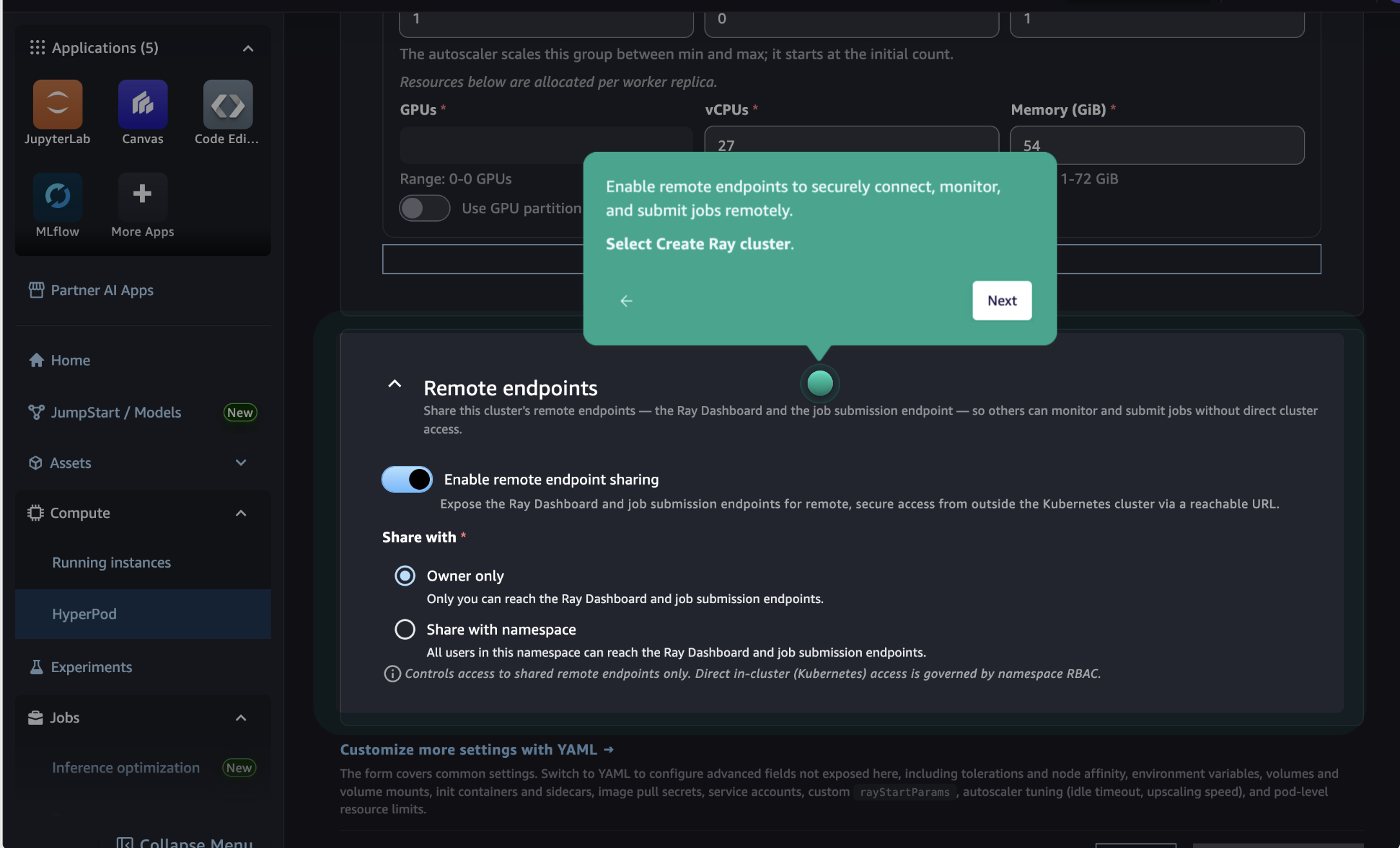
The availability statement is also specific. AWS says the capabilities are available in all regions where SageMaker HyperPod EKS is supported. The prerequisite stack includes a HyperPod EKS cluster, SageMaker Spaces EKS add-on, Observability add-on, KubeRay operator, HyperPod Ray Endpoint Operator, and a SageMaker Studio domain.
What is not proven by the launch is performance. The source note does not establish a price, latency, or throughput benchmark. AWS says existing scripts and workflows run without modification, but that is a compatibility claim and should be tested against real jobs, custom containers, dependencies, IAM policies, networking, storage paths, and cleanup routines.
The decision changes most for teams already using Ray or KubeRay around training, tuning, or serving workloads. If the integration works as described, it may reduce setup toil, make observability easier to reach from Studio, and improve recovery behavior during failures. But it does not remove the need to understand EKS, operators, quotas, IAM, storage costs, endpoint exposure, and failure semantics.
A sensible pilot should start with a noncritical Ray Train job. Run it through the new HyperPod path, enable checkpoint and recovery behavior, and compare setup time, operator maintenance, recovery time, dashboard usefulness, and failure handling with your existing KubeRay deployment. Then test a serving path separately if Ray Serve and IAM-authenticated remote endpoints are part of the intended use.
Verification should be practical rather than ceremonial. Confirm that Studio can create and manage the cluster, dashboards show the expected job and node signals, hung-job detection behaves as expected, recovery resumes from the intended checkpoint tier, and endpoint access follows the intended IAM boundary. Also verify quotas, egress paths, storage cost implications, and cleanup after failed or abandoned jobs.
Watch next for regional support changes, add-on and operator version requirements, clearer support boundaries between AWS-managed pieces and open-source Ray components, and real-world total cost reports. The launch is promising because it keeps Ray APIs in view, but the operational win depends on whether recovery, observability, and endpoint management reduce toil in your actual environment.